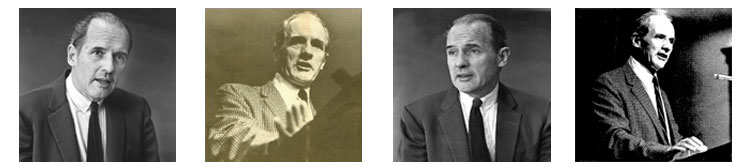
The Problem of Social History
Georgetown
University, Washington D.C. (April 17, 1974)
Lecture by Carroll
Quigley
INTRODUCTION: ...his bachelors, his
masters, and his PhD from Harvard University,
and he’s been teaching here
ever since. He’s the author of Evolution of Civilization and of Tragedy and Hope: A
History of the World In Our Time, and also of numerous articles in
Current History and other magazines. And I
suppose with that I
should introduce Dr. Carroll Quigley.
0:0:34
QUIGLEY: History is concerned with the
events of the past. But events don’t occur without expenditure of energy.
And human beings do not expend energy unless they have some reason. The
reason presumably being to satisfy some human need. Now, historians have
never asked themselves what are the basic human needs, how do they lead to
expenditures of energy in history, or any of the really fundamental
questions which create the events which presumably historians are studying.
In many fields, in many aspects of past events, other fields have analyzed
or asked these questions. For example, one of the most fundamental of human
needs is security. While historians don't spend much time dealing with
security, military strategists and political analysts and so forth have
spent a good deal of time. So what we could do as historians is go look at
what they have to say. When you come to social history, however, you don’t
find that situation. I would assume that if historians wanted to know what
are the basic social needs of man and what energies are expended in what
ways to satisfy those needs that they could go perhaps to sociologists. But
if you go to sociologists, you find that they are doing very much what
historians are doing except that they have removed from the picture much of
the past and are concerned with what is happening today. But essentially,
their approach is a descriptive approach, as to what is in any society, and
they usually restrict themselves to their own society. Now we get a good
deal of additional information, including the kind that I’m referring to
(basic human needs and the energies to satisfy them and so forth) from
another branch of what we might call sociology: comparative sociology.
The word we use for it is anthropology. Anthropologists are concerned with comparative approaches
to human ways of life and human events. And until relatively recently,
anthropology which is, in any case, a very recent field of human endeavor,
not much more than 150 years old, although it is quite true that
Herodotus in 450 BC could be called the first anthropologist. I would say
that perhaps thousands of years went by before the second one came along.
As a result, he’s rarely regarded as an anthropologist. But
anthropologists concern themselves very largely until quite recently, that
is for the last 40 or 50 years, with primitive peoples and not with
civilized or high civilizations or advanced societies. So we don’t get
very much help from any other discipline when we approach as historians the
events of the past from the social point of view.
0:04:09
For many
years, I taught a course here [at Georgetown] for freshmen, and while they
had never any problem when I spoke of the military aspect of a society (or
the political, the economic, or the religious, or intellectual, or various
others) in understanding what it was in general that I was talking about.
But whenever I spoke of the social aspect, they didn’t have any idea what I
was talking about. And accordingly, I discovered (usually after they had
done very badly on a question in an examination, which proves my lack of
perception as a teacher) that they hadn’t understood the question because
they didn't have any idea of what I meant by social. And accordingly, I used
to try to simplify it by giving them what we might call a descriptive
definition of the social aspect of history. Now before I go into that, I
want to give you the aspects that I generally demanded that they understand.
There are many many aspects of the human past and of any single event in the
human past. But I generally said to them, there are six that I want you to
always consider: those would be the military, and the political, and the
economic, and the social -- in recent years I have inserted above this
another one: emotional, religious, intellectual.
0:05:51
And
these seven aspects of events are the result of a variety of human needs.
The reason I put them in this way is because they are at a higher level it
seems to me of need. A level which makes them more man-like and less, shall
we say, animal-like. On this level, at the bottom, we would have security.
And if you read the original documents, which founded America, we were
looking for international security (which would be the military), domestic
tranquility (which would be the political) -- so we have the military and
the political. We have looked increasingly for prosperity and affluence
(which is, of course, the economic). Then comes this one that we're puzzling
about: the social; the emotional, the religious, and the intellectual. If
all of these different kinds of activities occur in history, there obviously
must be human needs -- and I will not make a list of the human needs over
here except that you can see it would be security. Now for domestic
tranquility, the chief problem would be settling disputes within the
group, just as the military's chief problem is defending the group as a
whole against outside intruders. So here you have group cooperation, on the
military level, to satisfy a need, which we could call if you nwish
"security." And then, settling disputes, and so forth. All of these various
needs. Now I think the needs are more or less obvious to you; certainly the
economic needs of food and shelter, and so forth, of various kinds are
perfectly clear. I think you would also say the military is perfectly clear:
weapons, and a defense force, and so forth. And perhaps, I'm not sure you
would know what the intellectual need of man would be. I would simply say it
is explanation -- and I usually put down what the need would be --
explanation. That is to say, men are not satisfied unless they have some
explanation as to what is happening to them, the reasons for it, why does
this thing happen, why does the sun rise in the East, why do the crops
appear at this time of year in the spring and die in the fall. Why, why,
why. It wouldn't be human if you didn't ask why. Although, I must confess
the majority of humans today apparently never ask why. But certainly
thousands of years ago, there was a more prevalent asking of the question
why.
0:08:53
Needs: Now the religious need. Again I think this is one
of the most difficult, but it is an assumption, and a need to feel that
there is some power or powers in the universe, stronger than we are, who can
either help us orwho are responsible for the things that happen to us, which
seem so out of character, unjust, unseemly, or whatever it happens to be.
There is a religious need. I myself would have great difficulty, I think,
giving a succinct definition of the religious need. But the proof that it is
there is in this: In any society where religion has been abolished -- not
just as a body of ritual and activities, but as a body of accepted belief --
the people have substituted for it something else. And today, where we have
a very unreligious world, and particularly perhaps in the European world,
and especially in the English speaking portion of the European world --
because I consider us part of Europe: Western Civilization--that in these
areas, you have secular religions. We are certainly today not a religious
people. But what you find today is an immense allegiance to ideological
slogans and symbols, and ideas, and so forth, which are clearly secular
religions. "Secular" means, of course, in the world of time and space, where
God we would think since about 500-600 BC would be outside of the
secular/temporal world and up in a world of eternity and unchanging
verities: you can call it "eternity" if you wish.
0:10:58
I do think this shows that there are religious needs, but what is the social
need? The social need is in some ways the most obvious. And yet today we not
only do not spend much effort on it, but we have absolutely no respect for
it. Today, people are rarely consciously influenced in decisions by social
needs -- and I emphasize all of those words. Because today, more than
anywhere in recent history, it seems to me, men are very definitely
motivated in decisions -- in unconscious decisions -- by unconscious
motivations, which rest in social frustrations and social inadequacies. Now
that idea I hope isn't too complicated for you. I'll give you what I mean by
that: Men need other people. It's perfectly obvious. If a child is born
and does not have associations with other people, he never becomes anything.
In fact, he won't survive. And for a couple of years, he must have the care
of other people to survive. But he needs much more than physical care; we've
now discovered this. Much more important than adequate nourishment in the
first two years or three years of life is -- I don't like to use this word
because it's a word that embarrasses people -- love. If an infant does not
have love in the first two years, does not have attention, and amazingly, is
not spoken to -- for example, we have many cases where even in our own
society infants growing up are not spoken to, they may be yelled at -- even
when they are adequately taken care of with regard to being kept clean and
bathed and fed, such as in infant asylums and institutions which have been
established for orphans or foundlings, you will find that they grow up
emotionally and mentally crippled. And it is absolutely irredeemable. (In
other words, you cannot get them at age twelve and make it up.) It's a
little bit like the fixations which animals get such as geese. You know a
goose always latches on the first moving object that it sees after it has
been out of the egg a certain number of minutes. It's supposed to
biologically -- the first moving thing that it sees should be its own
mother. So the result is little goslings should follow their own mothers
everywhere. But under the conditions in which we hatch eggs, there may not
be a goose around anywhere, so the first moving object they see may be the
dog or the cat or a man or a woman, and accordingly, they will follow them.
Everywhere. I remember trying to get rid of two ducks one time [audience
laughter], when we drove about twenty-five miles out past Potomac, to a farm
where they had a beautiful pond covered with ducks. And we put our two ducks
down and thought they’d go right in the water -- they hadn’t been swimming
in any water; we had no pond right here in Foxhall Village -- and that
they’d be happy, we could say goodbye and so forth. No, no, the minute we
put them down they turned around sat in front of us. So we started to walk
to the car and they came after us and came to the car. Well, I won’t get
into the long tale -- although the story does have a final, crash ending
[audience laughter] -- which is this: we find we have to leave them there,
on the edge of the pond, and run as fast as we could, me, and my -- I guess
it was just my older son who was at that time perhaps eight. We get in the
car and we dash off on a long drive, and as we drove out the front gates,
say half-a-mile away, we looked back and there were these two white things
coming down the road. So I drove rapidly back to Washington and the next
morning I was awakened at about six-thirty in the morning by "quack, quack,
quack, quack" outside the window. Now don’t jump to unscientific conclusions
that they followed us home because they were two different ducks. I don’t
where they came from [unintelligible 00:15:23] water again [audience
laughter].
0:15:27
Now human beings are the similar [sic]: they attach themselves to things. If
a child in the first two years is not dealt with affectionately, and this
involves not just talked to, but he must be held against the body -- or she
--the baby must be held against the body of another human being. Preferably
against the skin of another human being. And if they are not, they would be
crippled emotionally in various ways afterwards. You see this in the
kibbutz. I don’t know if you know anything about the Israeli kibbutz.
They’re very admirable things and they bring up the most extraordinary young
people, but they find it very difficult to relate personally to other human
beings. The most amazing thing of all is, I believe, there is no case known
of a child brought up a kibbutz married a girl brought up in the same
kibbutz. In other words, a kind of incest thing occurs there even though
they may not leave it until they are well-formed in their teens.
0:16:40
These
kind of emotional things we don’t have to go into, but people need other
people. They have to have. The worst thing you can do to a human being is to
cut him off totally from other people: solitary confinement, or coventry, or
whatever you want to call it. And even if they have been adequately prepared
-- treated -- in the first few years of life -- for instance this is what
happened to the Head Start program. The Head Start program was an effort to
take infants -- if you want to call them that -- at approximately age four
and take them into a schooling system and we have now found pretty
conclusively that age four is too late.They have to be got earlier. But to
get them earlier, you know, it makes big problems. And the point which I
raise, which is a very cynical point, is why should you take children in the
ghetto -- at age of one-week or whatever it is -- and treat them, let’s say
“properly” --if we do know the proper way to treat human beings. And then
have them grow up as sane, responsive human beings with an ability to relate
to other human beings. And throw them into a world like ours which is no
place for any sane well-balanced person to try and live. I don’t know
whether your silence indicates that you agree or disagree. But we have
clearly created -- or have created -- a world in which the insane are going
to be much more at home than the sane.
0:18:22
I
would like to add one other thing here. If we are historians, it is not
sufficient to list human needs because human needs are genetic: they are in
the genetic endowment of what you inherited through your genetic heritage
and they do not influence society. Society is influenced by desires. And
desires are not the same thing as human needs. They are the socialization of
a need into a desire. For example, people need food, but they desire the
kind of food which they were brought up to regard as food and will refuse to
eat those things which they were brought up to regard as garbage or
inedible. It’s happened in most of history that people who have starved to
death have starved to death because the desire, which they regard as food,
is not available, while in the context where they are, there is perfectly
adequate food, but it’s not what they were trained to regard as food. For
example, there’s no excuse for anyone at sea -- a castaway -- dying of
either hunger or thirst no matter how long they are floating on the ocean.
The only thing you have to worry about floating on the ocean really is the
sun, and if you can get a canvas over you, where there is steady sun, you
can find from the ocean plenty to eat: you just tie a handkerchief on a
string and trail it and you will find -- although you may not want this
as a steady diet -- that you will be collecting a great mass -- and it would
take only a few hours to collect it -- a great mass of what essentially is
shrimp cocktail. Now you can eat it without sauce [audience laughter] and it
is extremely nourishing.
There are other things -- I will not go into this -- but
a couple of weeks ago someone asked me -- a student -- what is the most
important thing for him to learn. And he was quite shocked when I said
“survival.” And I insist that that is the most important thing. So that you
can be thrown out in the world, as you may be in your lifetime, to survive
off of what is available. But in any case, social then is concerned with --
now, when I asked the students -- what do I mean —
0:20:56
If I asked “social,” “social history” let’s say of a country. In order to
simplify it, I gave them two things they should always watch for: what I
call “social aggregates” and “social classes.” By “social aggregates” I mean
those units in which relationships between people are arranged in the
particular society. The history of social aggregates is the history of the
changes in those units. Throughout history, those units or social aggregates
have been either local units, such as parishes, villages, or perhaps cities
later on and so forth, towns, or they have been kinship units, such as
clans, tribes, families or whatever it would be through relationships. These
are the two that in a very brief survey of the social history of any
culture, I will attempt to deal with. I want to point out certain things
here which are interesting. If you look at one of them, that is the social
aggregates, what you discover is that kinship groups break down and local
groups, geographical groups, get larger. So in an early period where the
society is totally rural -- and mostly cultures would start in a period
where they are largely or totally rural -- such as in the 17th century, the
United States was almost totally rural: it was in units, which we would call
“villages” and on the whole, kinship groups were not that significant. Where
on the other hand, you look at other societies or you go back into the
earlier history of Europe before America was settled, you’ll find that
kinship groups were much more significant. In some cultures, you find that
both are important. For example, in China, villages are important and clans
are important. That’s why they have, for example, ancestor worship, which is
the clan. In India, kinships groups -- if that's what the castes and
sub-castes are -- in other words, groups of relationships, are very
important. In the Islamic world, kinship groups are supreme, so that for
example, villages are torn to shreds in the Near East, in the Islamic world,
by the fighting -- even a small village -- between families. A person in the
Islamic world will generally trust no-one who isn't of his immediate family.
This is why the traditional preferred marriage in the Islamic world is a
marriage which is condemned in the Western Civilization as incestuous: that
is, first-cousin marriage. In the Islamic world, you are supposed to marry
-- and of course, it's like everything else, it's broken up in
recentgenerations, but it's still to some extent present -- you're supposed
to marry your parallel first cousin: that is your father's brother's
daughter. And it generally, in the traditional law of Islam, she cannot
marry anyone else or consider anyone else or an offer from anyone else or
anyone else's family until her cousin has said no. This is sexism of the
worst possible sort. I used to abrade a friend of mine who was pushing
forty. I only met him occasionally, but when I did I said, "Have you
released your cousin yet?" He said, "No, no, I may want to marry her." And I
said, "How old is she now." And he said, "Oh, she's thirty-something." And I
will not tell you what my next statement was because it was relatively
profane. I said, "You are an S.O.B. because you have at least five different
women a week, and you are saying to her that she has to sit there in Syria,
and die, because you will not say, "you're free to go marry somebody else,"
at a time when she could build up a family. Now in our Western Civilization,
as you know, this is the forbidden degrees of kindred. So the kind of units
that we are concerned with are these units of kinship.
0:25:48
To follow the history of any society, you will find that you go from rural
to an increasingly urbansituation; that you go from villages -- or possibly
large clans or even tribes -- toward a breaking down of kinship groups. So
it goes from clan to a lineage, to an extended family, to a nuclear family,
to a biological family -- to simply a husband and wife -- and then finally
to atomized individualism. Today we have practically reached atomized
individualism, not totally because the law is still there. I asked a
colleague of mine if he owned a certain house, right here, and he said,
"No, my wife does." Now, that is the ultimate you see. There are
jurisdictions still, one is -- well, West Virginia I know is one, where I
bought a piece of property and my wife had to come with me because it isn't
possible for a husband to own something without his wife having a claim in
on it.
0:27:03
So the atomization of individuals has not gone the whole way. You can tell
when it goes the whole way by looking at three things: First, how readily
can marriage be broken -- the appearance and state of divorce and we are
rapidly reaching a future, I think, in which there will not really be any
marriage -- when young people will live together and have a ball. There
seems to me actually a good deal of this at the moment and maybe ultimately.
That would be an atomized individual. The other is the rights of children.
When children have property rights from the moment they are born, which
their parents have nothing to do with and cannot touch, then this is an
atomization, you see. When a child can leave the home, at any time -- now in
Islam, today, still girls cannot, generally, leave the parental home. And it
was always understood that if a girl did anything like this, her father and
her brother had an obligation to kill her -- in traditional Islamic law.
Today, I know many people who leave the home when they go off as freshmen in
college and never come back. When their vacations come, they go off in
different places. This is this atomization of life which is a process.
0:28:38
When you have such atomization, relationships between individuals depend
entirely upon what we would regard as voluntary decisions: I will be your
friend or you will be my mistress or whatever it is, it's a voluntary
agreement of personal relationships. The personal relationships are very
brittle, they may break overnight, they have short duration, and there's a
tremendous amount of emotional voltage on them. This is one of the reasons
that marriages are disrupting so rapidly in our society today: it's because
other personal relationships have dwindled to very little. The result is
that your parents' generation, where they had a romantic theory of love and
married for love-- the one man in the world that was made for them, and so
forth and so forth -- this was a tremendously high voltage relationship. All
of their emotional needs had to be satisfied by this relationship with a
single person. It was never possible to do that, and the reason it wasn't is
because these needs are so diverse. The opposite goes with territorial
aggregates. Here, they were villages, then you have the beginnings of
commerce, the rise of towns, and then eventually you have cities, and so
forth and so forth. Now, we have to make a sharp distinction between what I
would call an "Asiatic society" and what I would call "Western society"
although I do not mean just Western Civilization. The difference is this: in
an Asiatic society, they make no effort to make the political unit into a
social unit. That is, a unit which satisfies the needs of human beings for
other people -- the gregarious need which is ultimately an emotional need --
they make no effort to do that. Instead, the government is essentially a
military taxing system, and it is above social groups, which we call
"communities" This is the reason that these Asiatic societies can go on, in
many cases for very, very long periods when the governing system -- the
political system -- has collapsed. They also, in addition to the state --
which in Asia might well be an empire, and they make no effort to make it a
social unit -- they also make no effort to make the civilization as a whole
a social unit. Instead, they have lesser social units: either villages,
neighborhoods, parishes, families, lineages, or whatever it is -- the social
units -- and these things have tremendous persistence and tremendous
satisfaction of the emotional needs and the social needs of other people.
0:31:57
For us to approach Asia -- let's say as a study area --
with the assumptions that we have in the West, namely, that the political
unit should be a social unit, and should be a community in which all men are
brothers, or beyond that, that the state should be expanded to include the
whole civilization in which all men would be brothers. We are told, for
example, by certain writers, that this was the dream of Alexander the Great:
to establish a brotherhood of mankind by creating a world empire. If so --
and I think there's certain evidence that it is so -- this is definitely not
an Asiatic idea; this is a Western idea. The civilizations which have
insisted that the political unit should be coterminous with the
civilization, and above all, that both of these -- whether they are
coterminous or not -- should be a community in which people are treated as
members of the same community and satisfied of their various needs and so
forth, have been -- I would say Classical Antiquity was the first; I don't
know any earlier. I think it could be well-argued that Byzantine
Civilization and perhaps even Russian Civilization were similar, certainly,
this is what Western Civilization has been. The reason that Western
Civilization is so very aggressive -- there are many reasons, but one of
them -- is this insistence that the political unit should be a community.
This breaks down because it's unsatisfactory for people. As a result, you
get terrific emotional frustrations.
0:33:55
Let me go into something else. Much of what happens on this social level is
the result of events on the economic level. Those events on the economic
level are the reorganization of the society by division of labor, by the
application of more productive forms of expending energy, and by exchange of
goods between specialist producers, and so forth, by heavy investment -- as
we would call it -- of capital, which is a method of using manpower and
other forms of energy. As a result, there has been a drive toward what we
would call "affluence." This drive toward affluence eventually becomes
unsatisfactory. Always. I won't go into the reasons why. What I would say is
people's desires for affluence cannot keep up with the processes by which
the production of affluence is achieved in any society. And the
organizational structures which you establish for achieving affluence -- and
I guess I have to put this in -- become institutionalized: become ends in
themselves. So that people are making their position in a specialized
economic activity the sole goal of their aspirations and are insatiable in
the affluence they hope to get out of it, such as controlling petroleum. And
the people in control of petroleum today have only one aim in life which is
to prevent the American people from recognizing that there are enormous
other sources of energy, many of which are practically free. If you feel
that there's a lack of energy in the world in which we live, you are greatly
mistaken, and I advise you to look at last week's weather reports. The power
in any one tornado -- and I will not go that far -- but certainly,
wind-power can be harnessed and replace all petroleum needs, but you're
never going to find it mentioned. Brookings Institution this month -- or, in
a couple of weeks -- is producing a book on energy needs and resources and
so forth. From the outline they've sent me -- the brochure about it -- it
doesn't mention anything except fossil fuels and nuclear. This, of course,
is what the people who control the thing want. Now because of these
restrictions by the people that control the organizational processes and
structures through which we satisfy needs, needs can never be satisfied to
the degree to which desires escalate. And desires escalate because of the
disruption of social context and the growing dissatisfactions of man's
gregarious needs and his emotional needs.
0:37:17
Because -- and you've heard the statement many times -- that no one is as
lonely as the person living by himself in a large city. I spent the summer
of 1940 living in Cambridge [Massachusetts], and it was absolutely
desperately, incredibly, lonely. I never want to live through it again. I
think in many cases, a day went by without me speaking to another human
being, which is no way to live. Yet, here I was in a big city, where I had
been living for nine years, at various times, and so forth.
0:37:50
You
disrupt social relationships when you shift, let us say, from a rural parish
to a village, to a town, to a city. And by disrupting those you disrupt the
satisfaction of gregarious needs, which come out of established personal
relationships with other people, relationships upon which you can rely not
relationships of the moment. Not picking up someone in the street and
finding there's a certain click, and you register that you can communicate
and so forth -- that isn't enough. It has to be something that you can feel
a certain permanency to it for it to be satisfying of your gregarious needs
and of your emotional needs. Now as emotional needs and gregarious needs
become increasingly frustrated, more and more energy is put into finding
what, I would call "substitutes." That is, you seek more satisfaction of
your economic needs for goods. So emotionally frustrated and socially
frustrated, and stultified movements, seem to substitute for these
inadequacies, loneliness, or whatever you want to call them -- or other
things -- getting more and more and more. And you get a relentless,
neurotic, and ultimately insane drive to acquire goods. And books have
called it the "acquisitive instinct." It isn't an instinct at all but it is
acquisitive. So that you have people who have incomes of a million dollars a
week, or in some cases -- a few cases -- a million dollars a day because
there are some people who have incomes that are close to 400 million a year.
These people are nevertheless working sixteen, eighteen hours a day trying
to make more money. They have no time at all to enjoy any goods that they
acquired before. Now that's our life. If a lot of people are doing that, it
becomes increasingly difficult to do it because they're competing with each
other. And accordingly, a society at a certain point begins to take those
energies, which are seeking more and more goods, and divert some of them
down into the political level.
0:40:29
Before
that, you will find that the economic expansion of any society is
accompanied by what we call the "commercialization of all human
relationships." That is, they are commercial relationships. I have seen
families where the father will say to the son, "Will you cut the front lawn
and I'll give you a dollar," or whatever it happens to be. Or, "Will you
shovel the snow on the driveway." These things become commercialized, not
put upon the basis of "I would like to have it done, and if you would do it,
it would be a great help to me," and so forth. But this commercialization of
all relationships does not become total until a society is just going to
destruction.
0:41:26
For example, in my lifetime, let's say in the past forty years in which I've
been very close to universities, higher education has become almost totally
commercialized. I think family life has become largely commercialized, and
so forth. What we might call the "commercialization of human relationships,"
but already fifty or a hundred years ago, the politicalization of life had
started. Now by the time politicalization is spreading -- in other words,
what this means is that if you want the knowledge you have to have power,
and your political relationships will determine what your incomes are going
to be, and you can increase your incomes through contacts. Now, I give
examples of this in my class and the students are utterly stunned: If you
knew the Department of Agriculture report on the wheat crop for the coming
year, 24 hours before it was published, you're going to become a
millionaire. And don't think this doesn't happen to some extent. Now, this
is the kind of contacts, you see, that makes it possible. And you will
generally find that today, immensely wealthy people are only immensely
wealthy -- that is, if they acquired it in their lifetime -- because
of political relationships of various kinds. So we have the politicalization
of life. But eventually, a lot of people enter upon that, so you get the
militarization of life, even later. Now this politicalization -- and when
you get the militarization of life, you get the kind of thing that we're
told is "imperialism" and war becomes increasingly common and so forth
because are using the unit, in which they are trying in our society to form
as a community to form into an aggressive military unit, to increase control
of the outside world and increase control of the factors of production, to
put it in economic terms.
0:43:47
Now I'm particularly interested when this goes on with
what happens up here [on his chalkboard]. What happens up here is you have
an emotional frustration, and people no longer get emotional satisfactions.
I'll give you a theory which you may not accept. I was thinking about it for
many, many years: What is it that gives people emotional satisfaction? I
could put it in a single word: functioning. The most satisfying emotional
thing there is is to do something that you are able to do. But it also has
to be something that you can justify as being worth doing, and that, of
course, gets you up to the religious, or the ideological, or the
intellectual level: to rationalize and justify. Let me make it a little less
abstract; "functioning" isn't enough. People get emotional satisfaction out
of existential relationships with other people or with nature. Now with
other people I mean, again, a personal face-to-face relationship, in which
it's a relationship between two unique personalities, such as never existed
before, and never will exist again, and indeed, that experience that you're
enjoying of the other person will never occur again. Every emotional
experience is unique. And therefore you cannot have a relationship with a
person as a category or a person in a category. You cannot have a relationship with a man, let us
say because you like army officers and he's an army officer -- something
like this -- or that you like wealthy men and he's a wealthy man. Or because
you like a person of a certain religion and he's of that religion or
something. As soon as you can characterize the person, it ceases to bean
existential relationship: it becomes a categorical, intellectual,
relationship, which is a totally different thing.
0:46:12
Similarly, with nature: It does no good to go out into nature if you are
characterizing it, you are not enjoying it. A lot of us will do that. It
helps in many ways to make it conscious, what you are experiencing. If, as
you go along, you say,"That is a Baltimore oriole that I hear." Or when I
walked through the woods this morning -- I shouldn't mention this because
some of you will go ahead and pick on them, and you should never pick
anything in the woods -- but I saw a great many Jack-in-the-pulpits. This is
the best year I've seen in twenty to twenty-five of Jack-in-the-pulpits,
just quarter-of-a-mile west of here.
0:46:54
Now, that's categorizing, but to have a relationship with
such a thing, and I hope you will not think I'm simply being poetical when I
say this, but it is possible to have an emotional relationship with a
Jack-in-the-pulpit. I mean it's an absolutely incredibly beautiful thing and
it is unique. You watch it change from this bright green to the brownish
purple it's going to be in, let's say, a week or so. It's all part of that
experience. Now human beings are emotionally satisfied only if they have
these kinds of existential relationships with other human beings, and with
nature. And like most social relationships, and I believe probably most
emotional relationships, they have to be relationships that you believe have
a certain persistence in them. It isn't enough to just have it in the
moment. I have had emotional relationships that lasted -- um, I'm thinking
of one in that summer of 1940 -- [pause] [audience laughter] Now I can go
back to it and it was a tremendous thing. To me, it was like looking at a
Jack-in-the-pulpit or maybe something like a Baltimore oriole -- the first
one of the year. I will never forget it, but I have no idea anything about her. Now since you are all toying with ideas, I will tell you I was in
a hospital [audience laughter] and someone came in and offered to rub my
back with alcohol -- and I will go no further except to say it was a most
satisfying experience [audience laughter]. That is an emotional experience.
0:48:49
Today, as the result of the urbanization, and
industrialization, and politicalization, and militarization of our society,
it is almost impossible to get in touch with another person on this kind of
a unique, personal, existential, relationship. Or to get in touch with
nature. We are constantly shut-off from other people and from nature by
categories, words, artifacts of all kinds, buildings, clothing -- streaking
didn't help -- and so forth. This is the reason today we have a society of
people who are enormously frustrated with a need for emotional experiences.
And here's what they do: they either make some symbol, or some slogan, or
some verbiage. And [the] intellectual [desire], which is supposed to give
explanation, today does not give explanation at all: it gives us ideology.
We have words that we get excited over, and slogans, and verbiage, and
symbols -- even when people don't have the slightest idea what the symbols
are. For instance, I'll say one that will shock you. The symbol for, what do
we call it, "women's lib," is a fist in a uterus. Now, this is beyond any
doubt if you study the history of symbols. This is what women's lib is all
about, but I know people who -- women's lib, they get so excited about it
that they go practically insane. And this is true of many, many things. I
walked down here, 35th Street, with a girl student, who was a pillar of
piety in many ways [audience laughter]. In those days they had decals on the
back of the car with American Flag, and every-time she passed one she'd say,
"fascist" [angrily]. An American Flag. Now, this is an emotional reaction.
Let me give you -- this morning's paper stunned me -- I'll give you a
horrible one. William Shockley, who of course is an idiot, is a technician
but he's called a scientist because America doesn't know the difference
between a technician and a scientist. There are very few scientists, the
world is run with technicians. For the benefit of the few who do not know,
William Shockley is the inventor of the transistor. And he's going around
the country, on what appear to be one-night-stands everywhere, preaching a
doctrine which is that the blacks are intellectually inferior for genetic
reasons. This is nonsense for half-a-dozen reasons that I won't get into.
For instance, the very word "black" is a meaningless word. He knows nothing
about genetics. The word "intelligence" is meaningless -- I will say flat:
there is no such thing as intelligence. There are many talents, and the
greatest authority on intelligence in American psychology says there are
thirty-six of them. I think that's overdoing it. I would say there are at
least five or six separate characteristics, for which a human being can be
tested, which we generally when they are used are designated as
intelligence. Intelligence tests are completely meaningless. Now I can say
that, because when I was about seventh-grade, or eleven or twelve --
this is when they first invented them. Stanford and Binet were both still
alive and kicking. It was administered to all of the students in the school
where I was, and I had been put in the seventh grade into a non-French
seventh. We had two levels: Upper level were French-seventh, lower level,
the incompetents [audience laughter]. Now, this isn't the reason, but you
see, as a child, I was known as a non-reader. But by 15, I was in Ripley's
Believe-It-Or-Not for having read a book a day for several years. So you see
you can remedy these things if you simply get motivated enough. I was the
highest one in that school in the intelligence test. Well, the teacher got
so excited about it -- I was disgusted [audience laughter]. They came
running in: "Oh, where is he!" And then all the--- [audience laughter]. In
the first place, I didn't in those days believe in intelligence, or
intelligence tests, or that they would indicate anything, but Shockey for
seventeen minutes last night, was shouted down at an educational institution
in New Haven [audience laughter], which makes me very sad. Because if an
idiot wants to go around the country preaching nonsense, by all means,
everyone should listen to him and recognize that it is nonsense and that
he is an idiot. Instead, if you shout him down, it's perfectly possible for
anyone to say, "This group of people refuse to listen to the truths that he
has to preach." And that is unfortunate. Let him show his wares-- or lack of
them.
0:55:17
The point I'm interested in is why does something like that happen. It
happens because of the emotional frustrations. People are going to get all
excited about words and so forth. This morning's paper is filled with it. I
could have brought in this morning's paper and given you quite a lecture
upon what's the matter with the United States. Here we see a hold-up and the
debate is whether Miss Hearst is or is not a willing and active participant
in the hold-up, which to me is a minor matter. I am interested in -- I think
her name is Mrs. Hill, I may be wrong [i.e.,actually, Nancy Ling Perry] --
who ten years ago was a violent supporter of Barry Goldwater, then became
apparently some kind of a lesbian, and has love poetry written by her
girlfriend, then married a negro whom she lived with for several years, left
him two years ago and became a participant and advocate of violence against
everybody. And when she got a job at a fruit juice stand, selling -- well
[to someone in the audience] you're doing this [gesture] to mean that she's
insane, but this is categorizing you see. The world is not made up of sane
and insane people. These categories are meaningless. When she was working
at a fruit juice stand and apparently the customers were not demanding grape
juice that fast, she cut her hand, collected the blood and wrote on the
stand, "Death to pigs.” Here is a person -- and you're all thinking, "Oh,
she's a minority." There are probably millions like her in the world. If you
simply look through the paper this morning, there are dozens and dozens of
them reported. Two boys about eighteen stopped at Frederick, Maryland, go
into the police laughing and joking. The police said, "What do you want?"
They said, "We murdered my mother and my sister last night." Well, they
won't believe it. And they say, "Will you go back? Where are they?" Up near
Gettysburg or somewhere, and so forth, and you'll see it in the paper if you
haven't already. It was true: a six-year-old sister, a forty-year-old mother
strangled. One of the most horrible ways to die, really, by an
eighteen-year-old. Why do things like this happen? Now, I will not continue
to narrate what's in the morning paper, but what's in morning paper isn't a
small fraction of what happened in the United States yesterday. The reason
for this is this tremendous emotional frustration, which comes from two
basic things: the fact that we cannot establish -- or it's very difficult
today to establish -- emotional experiences on an existential basis
because of the barriers. And the barriers between are both organizational,
artifactual, and intellectual. Because intellect is no longer explanations,
it is slogans and verbiage, and so forth, to get people excited. When
students, or any other group, make demands; they are not making demands
because this is something they want. They are making demands because making
demands will lead to an emotional experience by leading toward a
confrontation.
0:59:12
Out
of this comes, as you can see, a really horrible situation. What happens?
What happens is -- as past history shows -- groups of people begin to leave
the society: cop-outs. "Opt-outs" I;d say just because I like to use Latin.
"Opto" [I choose] out. And they go into what you would call "communes." Now
because they don't know what's wrong -- they do not know what a community is
-- they go into a commune. A commune is self-defeating because you cannot
have a community unless you have differences. All satisfying emotional, and
social relationships are with people who are different, and you cannot make
them with people who are the same. In a commune -- and this is very
noticeable among students, and Americans increasingly, our students of the
past now moving up and it occurs amongst everyone around forty now. They
associate only among people of the same age -- "peer groups," we call it.
This is not the way, a hundred years ago, America was. A hundred years ago,
all associations were with people older and younger. Furthermore, all social
activities were activities for all ages or for families. The Fourth of July
picnic, and celebration, and fireworks displays, which is one of the big
moments of the year -- or any other moments that you want to mention:
Christmas, or New Year's Eve -- always was, back in the old days, made up of
people of all sexes, all ages, and frequently of many different economic
statuses. Here, I would like to throw in something very quickly -- I'm going
to stop in a moment because I don't want to talk too long.
01:01:17
Social classes -- we are increasingly getting histories
of social classes. Anyone who writes a history of social class and doesn't
know what he means by social class or what social class is, his work should
be destroyed.But it isn't. It's published, and read, and repeated. Social
class must be defined in some way where you can analyze, prove, or disprove.
It certainly is not based upon economic income or any of these other things.
It is based upon something else, and I will put it very succinctly and at
the core of it: social class is based upon cognitive assumptions. Cognitive
assumptions are the assumptions that any individual, or society, or a group
have, regarding how human experience is categorized and the valuations put
upon the categories. These are, almost universally, unconscious assumptions,
which you absorbed when you were being socialized as a child, and then when
you went to school to be socialized. It's an amazing thing that in
bringing up children in families, and in sending children to school and
educating them, no one had ever looked at this, or had anything to do really
with cognitive assumptions-- it's been an accidental thing. When negroes
say, for example, that it's unfair to ask them to take our achievement tests
or intelligence tests and so forth, they are perfectly right. Because our
achievement tests and our competitive grading systems are all based upon
cognitive assumptions, to the point that I would say this: the outstanding
students, the ones that invariably perform brilliantly on examinations and
get A's, are not nearly as good as the B+'s behind them. Because the B+ is a
person who can see there are other ways of looking at it, and he can bring
up alternative views. [That] those alternative views are rejected by
everyone, including the professor or the grader, does not mean that they are
necessarily wrong. They have to be analyzed in terms of the context of all
the assumptions you are grading the papers in such a way that you give an A.
This becomes very difficult to a person, like myself, who is aware of these
things, but I generally compensate for it by writing more strong, and more
powerful, letters of recommendation for B+'s or B's than for A's. In fact,
I've written some for people who got C's and D's, who went on and achieved
brilliantly.
01:04:18
Now
I'll stop at this point simply because the subject is endless -- Oh, one
other thing. Social classes. We deal with social classes and believe people
should relate only to their own social class: workers to workers, petit
bourgeoise to petit-bourgeoise, gentry or aristocracy with so forth and so
forth. This, not only is untrue, but it is not what the historical
experience of the world shows.
[END OF LECTURE]
Audio of Lecture