About
The Public Administration of the Napoleonic Kingdom of Italy
"My doctoral dissertation on The Public
Administration of the Napoleonic Kingdom of Italy was never published
because over-specialized experts who read the version revised for
publication persisted in rejecting the aspects of the book in which they
were not specialists. The only man who read it and had the slightest
idea what it was all about was Salvemini, the great historian from the
University of Florence, who was a refugee in this country at the time.
The book's message could be understood only by an historian who knew the
history of Italy, France, and Austria, and was equally familiar with
events before the French Revolution and afterwards. But these national
and chronological boundaries are exactly the ones recent historians
hesitate to cross..."
Carroll Quigley. The Oscar Iden Lectures.
1976.
From Tragedy and Hope
"The hope for the twentieth century rests on recognition that war and
depression are man-made, and needless. They can be avoided in the future
by turning from the nineteenth-century characteristics just mentioned
(materialism, selfishness, false values, hypocrisy, and secret vices)
and going back to other characteristics that our Western Society has
always regarded as virtues: generosity, compassion, cooperation,
rationality, and foresight, and finding a increased role in human life
for love, spirituality, charity, and self discipline."
Carroll Quigley. Tragedy and Hope. 1st ed. 1966. p. 1310-1311
Further Reading on Tragedy and Hope
Robert R. Rea's review of Tragedy and Hope
Leften Stavrianos' review of Tragedy and Hope
Robin Ramsay's review of Tragedy and Hope
"Quigley ... Making Bircher's Bark" -
by Wes Christenson
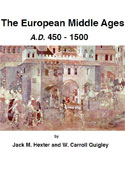
From The European Middle Ages
"In our study of the
medieval period of Western Civilization we shall study how wealth was
organized and then how force was organized. Next we shall see how the
organization of wealth was changed and finally we shall see how the
organization of force was changed. Lastly, we shall examine changes in
the Civilization's ideology and social organization, particularly
specific medieval institutions like the Church and the feudal
monarchies."
Carroll Quigley.
The European Middle Ages. 1969. p. 2
From The Anglo-American Establishment
"One wintry afternoon in 1891, three men were engaged in earnest
conversation in London. From that conversation were to flow consequences
of the greatest importance to the British Empire and to the world as a
whole. For these men were organizing a secret society that was, for more
than 50 years, to be one of the most important forces in the formulation
and execution of British imperial and foreign policy.
The three men thus engaged were already well known in England. The
leader was Cecil Rhodes, fabulously wealthy empire builder and the most
important person in South Africa. The second was William T. Stead, the
most famous, and probably also the most sensational, journalist of the
day. The third was Reginald Baliol Brett, later known as Lord Esher,
friend and confidant of Queen Victoria, and later to be the most
influential adviser of King Edward VII and King George V."
Carroll Quigley. The Anglo-American Establishment. 1st ed.
1981. p. 3
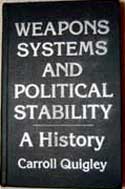
From Weapons Systems and Political Stability
"One thing we learn from
experience with power is that force is effective in subjecting the will
of one person or group to that of another person or group only in a
specific situation. There can be no general subordination of wills,
because, as situations change, the wills of both parties may change."
Carroll Quigley. Weapons Systems
and Political Stability. 1st ed. 1983. p. 35
Further Reading on Weapons Systems and Political Stability
Chester G. Starr's review of Weapons Systems and Political
Stability
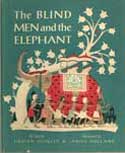
From The Blind Men and The Elephant
"The Rajah is right. Each one of
us knows only a part. To find out the whole truth
we must put all the parts together."
Lillian Fox Quigley. The Blind Men and
The Elephant. 1st ed. 1959. p. 25
From Ireland
"The history of any country is
determined to a great extent by it's past, but in Ireland this has become an
obsession ."
Lillian Fox Quigley. Ireland. 1966. p.
24.
|
|
|
|
|
Please email the editors (editors@carrollquigley.net)
with corrections, questions, or if you have other works by Professor Quigley you
would like to see posted.
©2008-2026 All rights reserved. CarrollQuigley.net |
|
|
Website hosting gratuitously provided by
AVAREN [Dallas Fort Worth IT Consulting]
quibgley quiglsey quiglesy quiglety quigleyt quigle6y
quigley6 quigle7y quigley7 quigleuy quigleyu
|