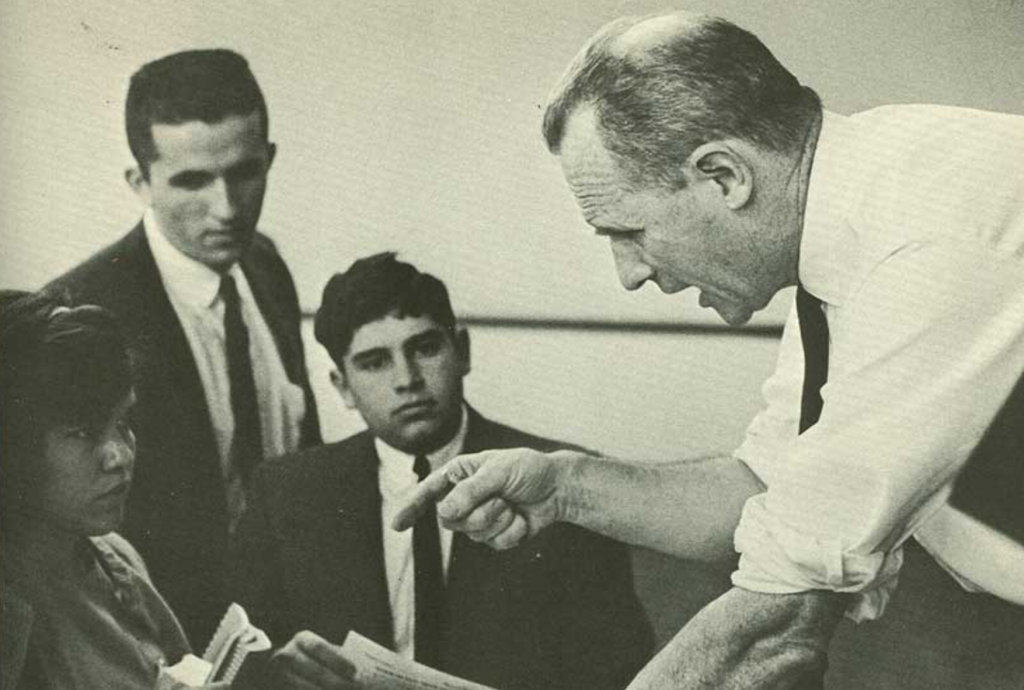
Quigley with Student. Photo from the 1966 edition of the Protocol, the SFS,
yearbook.
_________________________________________________________________
For 35 years, one Georgetown professor taught more students
by far than any other instructor. But numbers alone do not tell the
story. Surveys of alumni, and stories from those he taught and
mentored, show how this man was most admired.
Carroll Quigley was born in Boston in 1910 and attended the
Boston Latin School from 1924 to 1929.
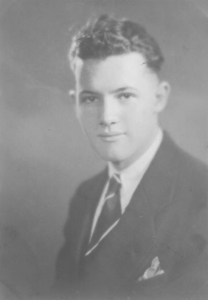
Quigley went on to Harvard where he graduated magna cum laude and as
the top history student in his class. He wrote his doctoral
dissertation on the Napoleonic public administration of the Kingdom
of Italy (1805 to 1814). Quigley was a master of
macro-history—development of civilizations, medieval history, modern
European history—and of micro-history—English history since the
Tudors, Russian History, and the History of France (1461 to 1815).
Perhaps the most famous of Quigley’s students, President Bill
Clinton (SFS’68), recalled the impact Quigley had on him in him both
in his 2004 memoir and famously in his
speech at the 1992 Democratic National Convention.
In My Life, Clinton wrote, “The most legendary class
at Georgetown was Professor Carroll Quigley’s Development of
Civilizations, a requirement for all freshmen, with more than two
hundred people in each class. Though difficult, the class was wildly
popular because of Quigley’s intellect, opinions, and antics.”
One of Quigley’s most lasting insights,
Clinton explained, concerned “the key to the greatness of
Western Civilization, and its continuing capacity for reform and
renewal.”
“He said our civilization’s success is rooted in unique
religious and philosophical convictions: that man is basically
good; that there is truth, but no finite mortal has it; that we
can get closer to the truth only by working together; and that
through faith and good works, we can have a better life in this
world and a reward in the next.”
Many have written about Quigley’s illustrious tenure at the
School of Foreign Service and the generations of students he
taught and advised, but few know the story of how Carroll
Quigley came to Georgetown.
In 1940, a Jesuit at Georgetown met an old retired Army colonel
named George Catlin. Colonel Catlin worked in the old Munitions
Building headquarters of the Department of War. Catlin, a New
York native and graduate of Columbia University, had served in
the Spanish American War.
Quigley said of Catlin in a 1974 interview, “He spoke fluent
French [and was] very cultured. I had met him when he was in the
Graduate School at Harvard when he was already about 60.”
_________________________________________________________________
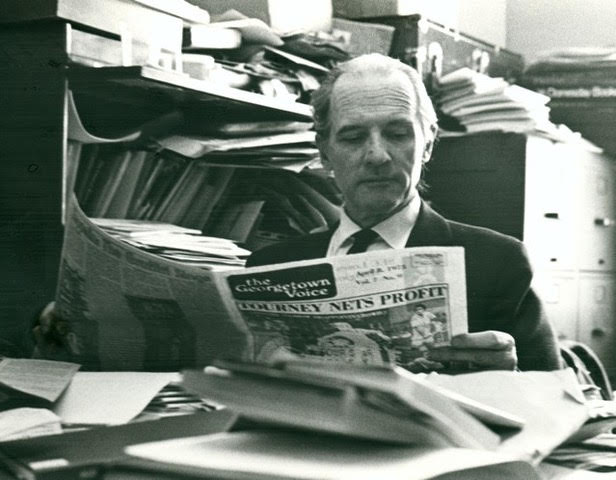
Quigley reading The Georgetown Voice in 1973.
_________________________________________________________________
As it happened, Father Walsh had already brought another history
teacher, Paul R. Doolin, down from Harvard. Quigley recalled
that while Doolin was good at teaching graduate students, his
style did not suit undergraduates. “He talked too remotely and
abstractly,” Quigley said. Father Walsh was looking for a
teacher who could bring history alive for his undergraduates.
Catlin told the Jesuit he knew just the man from Harvard and his
name was Carroll Quigley. Quigley recalled, “This Jesuit says to
Fr. Walsh, ‘I hear there’s somebody good at Harvard and I think
Paul Doolin knows him.’ So they asked Paul Doolin, and he said,
‘If you can get Quigley, you’re lucky.’”
“Everyone thought, since Fr. Walsh was an Irishman from Boston,
that’s how I came down here, but it was the Harvard connection.
In the fall of ’41, I thought I’d stay five years and write a
book or two books, but the War came and caught me—in
December—after a couple of months,” Quigley said.
Quigley remembered: “In 1937 I went to France and to Italy, and
did research. I was gone a year. And my wife went with me. She
was a Princeton girl. She’s my wife now. She and her father
lived in the town. I married her in May of 1937, and in July we
went to Europe.
“We got back about a year later. And before the boat docked in
New York I got a message on the wireless from Harvard offering
me a job. I did three years at Harvard and then Fr. Walsh got in
touch with me and asked me to come down and teach here. But I
couldn’t come. He asked me on the 7th of September, 1940, which
was the day of the big destroyers deal.
“I came down and interviewed, because I was at Princeton for the
summer with my wife’s family. It was easy enough. And [Walsh]
interviewed me and he wanted me to start that month in a few
weeks. And I said I couldn’t do that, ‘I’m committed to Harvard
for another year. He said: ‘All right. Come next year’.
“I mean, I couldn’t move. I had an apartment that I had paid
rent on already for September in Cambridge. So I came down here
in September 1941, that’s three or four months before Pearl
Harbor. I said, ‘I have been a tutor at Harvard for three years,
as a private tutor, with honor students. At Princeton I did
mostly what they call ‘preceptorials’. That’s discussion groups
of seven.
“But I had lectured at Princeton, maybe twice a year to big
classes. Now, I knew there was something about my lecturing that
was good, and I’ll tell you why. I lectured, for instance, upon
two different topics, and in the final exam almost every student
brought those things in, even when they weren’t relevant. I had
made an impact on them.
“I knew they didn’t have sense enough to know it didn’t really
fit the answer. So I wanted practice, and this is what Walsh
offered me. He said you will do nothing but lecture. And he
said: ‘You have three classes’ and so forth. As a matter of
fact, when this happened, the lecturing was much greater than I
ever realized, and I’ll tell you why.
“I came down in September of ’41. Pearl Harbor came. And half
the faculty went off to war. They were called up that Monday.
And they were all in Reserves and everything. I took over
courses. I even taught college algebra, because we got word that
our students from the Foreign Service School were having trouble
getting officer candidate nominations, and so forth, because
they couldn’t handle math.”
The Second World War brought great change to the School of
Foreign Service. Many of the civilian students were drafted.
Quigley took on other professors’ courses as they went off to
war.
“I was teaching European History but then Samuel Adams Dulany
Hunter, who was the great teacher of United States History went
off to war,” Quigley said. “And I took over one course after
another because I was left here. I don’t know why I was left.
Except that Fr. Walsh one time told me, ‘You were left here
because I insisted on it.’”
In 1943, the Army Specialized Training Program came to SFS. They
needed American soldiers trained for the impending military
occupation of defeated countries. SFS rapidly transformed to
meet the need. Father Walsh put Quigley in charge of Central
European programs.
During one week in the summer of 1943, Quigley lectured for
twenty-nine hours to a group of seven hundred soldiers on
Central European history in Gaston Hall—with no air
conditioning.
“I was in Gaston Hall, which had no air-conditioning, talking to
seven hundred fifty men—who had just had their heavy mid-day
meal—at 1 pm. And I had to keep them alert, and alive, and
excited. And on my platform (I had a thermometer up against the
back of the platform) it was over 100 degrees all the time. And
humid as hell. I was so stuffy in those days, that it was
difficult for me to take off a jacket—this helped to break
that.”
By the end of 1944, those soldiers had moved on to their foreign
posts, and Professor Carroll Quigley was well on his way to
earning his status as a legend of the School of Foreign
Service—who would continue teaching at Georgetown until 1976.
As Austin Hyde (SFS’63) wrote in October 1961, “Dr. Quigley, in
a unique way, bears out Henry Adams’ observation that, ‘A
teacher affects eternity; he can never tell where his influence
stops.’”
“There are no means available to measure the intellectual impact
and the far-reaching effects of his influence on the minds of
his students. For this reason it is impossible to give Dr.
Quigley recognition commensurate with his value to thousands of
Georgetown students since his arrival here from Harvard in the
Fall of 1941.”
_________________________________________________________________
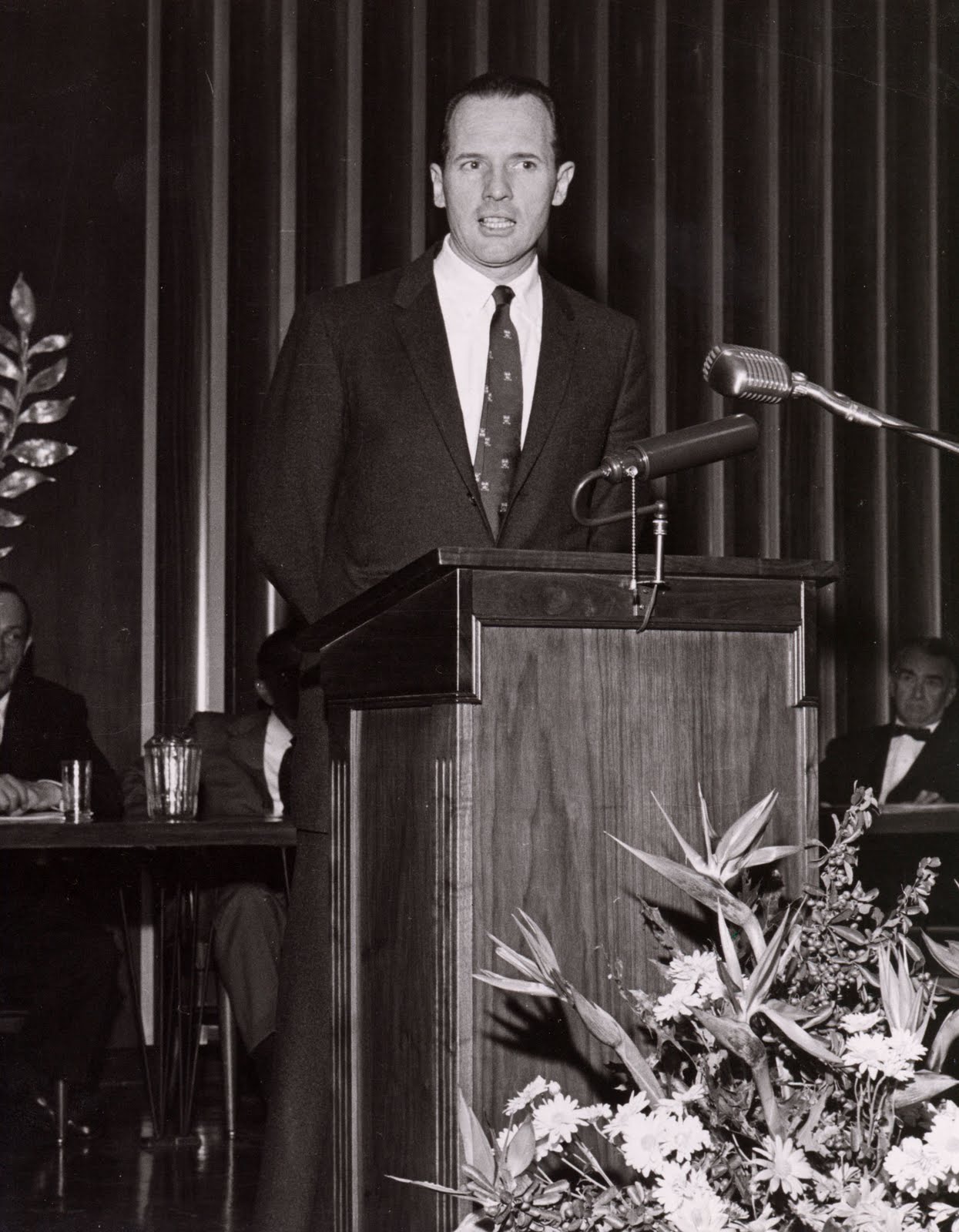
Quigley speaking in 1961.
_________________________________________________________________