Theology
Thursday, Nov 3, 1966 THE HOYA
Letters to the Editor...
To the Editor:
On all sides strident voices make demands, and controversies emerge from
these demands. But, in most cases, the demands are beside the point, and the
controversies rage over irrelevancies.
This will undoubtedly be true of the recent student demand that required
theology courses be re duced to electives. If this is done, it is clear that
very few students will elect them. And will these students then be better off or
better educated? I doubt it.
Theology should be the most exciting and relevant subject on the campus. It is
not now and has not been for decades. This is clear from many years of student
com plaints aimed at the required theology courses (and, to a somewhat less
degree, at the required philosophy courses). These courses have been bad
courses, misconceived and badly taught, despite the fact that they have, in
name at least, been concerned with the most important subject in the curriculum, a subject which the student will get nowhere else, if he does not get
it here, and a subject whose content is, intrinsically, the most interesting and
most exciting one there is.
Instead of demanding that theology courses be made elective, so that they may
avoid taking them, students should have been demanding, for the last generation
or more, that the theology courses be improved. Instead, they now de mand that
they be made electives, obviously a step toward their large scale neglect (like
ancient Greek). This would be one more episode in the mad rush of Catholic
education in this country to ape the secular, endowed universities, without any
real consideration of the question if the secular university practices are good
or bad, in terms of Catholic education.
Catholic education in this country has a great opportunity to do a job which
badly needs to be done and which it, more than others, should be able to do. I
mean to provide the opportunity for young people to get acquainted with the
traditions of Christian culture. And, in these traditions, a major place should
be reserved for theology. I do not say that young people should be
indoctrinated, either with the traditions of Christian culture or with the
theological discoveries of those traditions. But they should have the opportunity to become acquainted with them. Catholic education has failed miserably
in providing this opportunity; just as the secular universities have failed,
in a different way. And it is no solution to the problem that Catholic
institutions should, in response to student protests at their failure to do
this task in an acceptable way, rush further along the path toward meaningless
eclecticism from which the secular universities are, even now, recoiling.
Some years ago, the alumni of twelve successive classes of the Foreign Service
School (1949-1960) were sent questionnaires regarding their undergraduate
courses. The most notable feature of their replies was the consensus of adverse
criticism of the courses in theology. At the time, I felt deep Sorrow at this
tragic failure of a great educational opportunity. I feel the same sorrow now at
the present student demands that these courses be made elective. Are there no
leaders, either among the stu dents or elsewhere, who will direct these demands
in the correct di rection, namely that way as its importance requires?
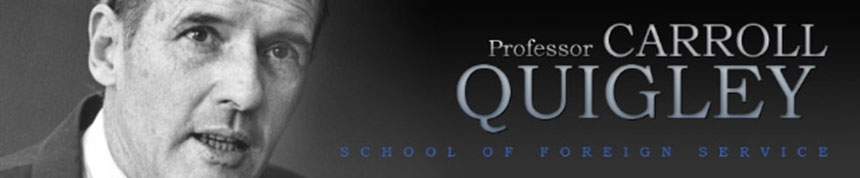
Carroll Quigley
Professor of History
Scan of original
article