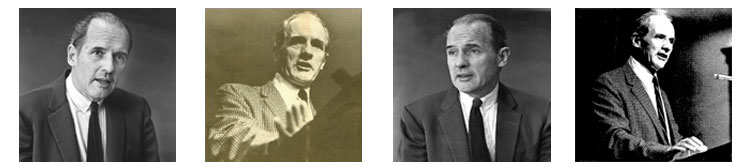
"Public Authority and the
State in the Western Tradition:
A Thousand Years of Growth, A.D. 976 - 1976"
by Carroll Quigley Ph.D.
I: "The State of Communities", A.D. 976 - 1576
by Carroll Quigley Ph.D.
0:00:01
[Introduction by SFS Dean Peter F. Krogh]
0:04:03
Dean Krogh, Ladies and Gentlemen,
.... and the people who laughed at that.
0:04:14
For a decade from 1931 to 1941, my chief intellectual concern was with the
growth of public authority and the development of the European state. I
dreamed at that time that, at some date in the future, perhaps thirty years
in the future, I would write the definitive history of the growth of the
European state. But in 1941, I had to postpone indefinitely, and
gradually abandoned, that project. I no longer after 1941 had adequate
libraries (and it would take a very extraordinary library for the purpose,
of which there are only a couple in the United States, perhaps). I was much
too busy with my teaching -- which I enjoyed thoroughly.
0:05:15
But above all, I discovered that
other historians were so specialized in their studies, and were so lacking
in basic historical concepts (such as: What does "state" mean? In what way
is "state" different from many other things, such as "public authority",
"government", and so forth?) that they could not understand what I had to
say. And I had a bitter experience which revealed that, namely in my
doctoral dissertation, which was on "The Public Administration of the
Napoleonic Kingdom of Italy," which I wrote between 1936 and 1938.
0:06:11
I will not go into the story, I will simply say there was only one man who
read it, who had the slightest idea what it was all about. And that was the
great University of Florence historian, Salvemini, who at that time was a
refugee in this country. But most historians knew only one country.
They knew England, or they knew France, or they might have known Italy,
they might have known Germany. And most historians knew only certain
periods And, of course, the period I was writing about, the
Napoleonic Kingdom of Italy, was technically from 1805 to 1814. And anyone
who knew that period, I discovered, really didn't know anything about, had,
what the situation had been like before the Revolution, the French
Revolution of 1789.
0:07:06
So, instead of writing that, I got into what, I suppose, was really my much
stronger activity: the creation of the necessary conceptual paradigms,
structures, frameworks, for understanding historical processes. Because I
discovered that people could not, historians could not even understand their
own specialties, because of their lack of concepts.
0:07:44
Let me give you two examples of this, one very contemporary, i.e.,
it's last last hundred years, which for me is contemporary. There is an
area of political activity, and for about a hundred years, and in all
political argument and controversy to-day, there is a basic assumption that
only two kinds of interests or entities operate in the area of political
action, i.e., individuals and the government. There have been
numerous books published, whith such titles as Man vs. the State. I
know of two of those. They both appeared, I think, in 1906. We hear about
Big Government as a threat to the individual, and so forth and so forth.
Conservatives now are telling us that we must curtail government, cut
government spending, cut government powers, reduce government personnel, for
the sake of making individuals more free. Liberals, on the other hand, are
still telling us, as they have for a long, long time, that, in order to make
individuals free, we must destroy communities. By communities, I mean
villages, ghettoes in cities, ethnic groupings, religious groupings,
anything which is segregated. We must destroy them, so that all individuals
would be, if possible, identical, including boys and girls.
0:09:51
But the area of political action, and I won't draw it on here, but just
assume a circle of political action, in which you have: government,
individuals, acting in there. But you also have at least two other groups,
really three others: voluntary associations, which I'll say no more about,
corporations, and communities. And if the Liberals destroy communities for
the sake of the individual; and the Conservatives destroy state government
for the sake of individuals, you're going to have an area of political
action in which irresponsible and immensely powerful corporations are
engaged upon, in opposition to individuals who are socially naked and
in[deed] defenseless.
0:11:00
And what we get in history is never what anyone is struggling for. What we
get in history is the resultant of diverse groups studying, struggling; and,
if Liberals and Conservatives are struggling for these things, that is what
the result will be. That's one example of a lack of a paradigm. I have
given you the paradigm.
0:11:27
The next thing is more personal. A number of years ago, an old friend of
mine -- we were colleagues at Princeton in the History Department in 1936
and '37 -- wrote a book, The Age of the Eighteenth Century, the
Democratic Revolution. Now, since neither of the revolutions that he
talked about were democratic. Neither the one in France nor the one in the
United States were not intended to be, and did not turn out to be,
democratic revolutions, people have changed this and talk about "The
Eighteenth Century Revolution", but they talk as if the Eighteenth Century
Revolution in, let us say, the United States, and France and in other
places, was the same kind of a revolution.
0:12:28
Now, Bob Palmer is a very industrious person, with a very agile mind, and a
ready verbalizer; but he does not know what he means by "revolution" or by
"democratic." And he's totally wrong if he believes the
Eighteenth Century Revolution in the United States, or the English-speaking
world in general, was the same as the Eighteenth Century Revolution in
France. In fact, they were the opposite. The revolution in France was a
struggle by a government which did not have sovereignty to obtain
sovereignty, which to us would be the essential, identifying characteristic
of any state. Sovereignty. The English-speaking revolution, through the
Eighteenth Century, and in the United States, very clearly was an effort by
states who had sovereignty to curtail it, divide it up, hamper it, by such
things as federalism, separation of powers, electoral colleges, and so forth
and so forth.
0:13:53
Now this is what I mean by the need for paradigms. The basic entity to
understand is the civilization as a whole. And although I give you the date
that I'm going to talk about, the last thousand years, Western Civilization,
of which we are a part, has
been around for a considerable time longer than that. I think that we might
say, perhaps, that Western Civilization began around 600. It came out of
the ruins and wreckage of the preceding Classical Civilization. And
Classical Civilization's dates might well be 1100 B.C., through a Dark Age
of 1000 B.C., and it ended by about 550 A.D., and was followed by a
Dark Age around 850 or 876 [A.D.], a hundred years before the outline
begins this lecture.
0:15:05
Out of the wreckage of Classical Civilization, which was [on] the shores of
the Mediterranean Sea. That was Classical Civilization. And it was held
together by the fact that the ease of water transportation on the
Mediterranean was so superior to the difficulties of land transportation
away from the shores of the Mediterranean
Sea, that the city of Rome could bring its food from Egypt when it could not
bring food from Lombardy in Italy. And anywhere in the Mediterranean Sea,
even at the height of the Roman Empire, if you went into the interior a few
hundred miles, you had left Civilization. That civilization perished and
out of the wreckage came four other civilizations: Islam, Byzantium, Russia
and Western. And I think we might say they all were, sort of, around from
600 onward, and certainly by 950 they were around.
0:16:29
Now, another paradigm that I want to establish is a difference between two
kinds of civilizations, which means a difference between two kinds of
governments in these. Asiatic civilizations, generally, do not attempt to
deal with individuals or with the problems of individuals. I have always
called that Class B Civilization. Class A Civilization is the kind of
civilization that's Classical Antiquity, Classical Civilization, turned
into, the kind that we are moving toward, and have been from the beginning,
or the kind that was found in the first Chinese Civilization, which was from
1800 B.C. to 400 A.D., and is distinguished from the Chinese
Civilization which was from 400 [A.D.} until about 1930. We call that
earlier one Sinic -- s-i-n-i-c -- from the Latin word for China, which is
Sinia. In those Class A Civilizations, although the civilization starts by
being an area of common culture made up of communities, in our type of
civilization there is a long term trend to destroy and break down
communities.
0:18:14
Now, the way I would like to express it would be, and this is all on the
back, blackboard, by saying that a civilization, all civilizations start out
as aggregations of communities. Those communities are generally of two
types, either local (such as parishes, neighborhoods, villages, manors, or
whatever else they may be) or kinship communities ([such as] families,
clans, or so forth). And at, when a civilization begins with communities
such as this, and ours in 600, let us say, there is no state and there is no
atomized individual.
0:19:04
Now, I won't go into details of this, but in such communities everything is
different. There are no written laws; it's all customary. All controls, or
most controls are what I call internalized, i.e., they're built into
your hormones and your neurological responses. And you do what is necessary
to remain a member of the community; because, if you weren't a member of the
community, you would be nothing. You would not be a man. And as you may
know, if you have ever studied linguistics, many of the names which
primitive people have for, even not-quite-so-primitive people, have for
themselves is their word for man. That is, unless you were a member of
their community, you were not a man.
0:19:59
Now, what happens in the course of a civilization, if it's an A like ours,
take a thousand or more years (It took fifteen hundred years to Sinic
Civilization and it took about a thousand years with Classical Antiquity) is
that those communities are broken up, and gradually break down in smaller
and smaller groups, and may end up simply as what we call nuclear families,
a father and a mother. And then you will discover they lose all
of their discipline and control of their own children. And the only holder
of the control is the XXXX isolated individuals, and so forth. And
what happens is, you end up with a state which is not only sovereign, but
totalitarian, and it is filled with isolated individuals who face a
totalitarian state.
0:21:07
The communities, of course, from which Classical Antiquity came, were
clans, i.e., kinship groups. The communities from which Western
Civilization came were local villages and manors. And, indeed, the
communities always are either one or the other. And lucky civilizations,
such as Chinese Civilization over the last 1500 years or more, have
generally communities which are both kinship and local. If a society has
just kinship communities, like Islamic Civilization, it is in a very, very
bad position. It never, for example, can understand the meaning of the word
"state". For Islam[ic] there is no Arabic word for the state. And you may
reach the point that the Arabs tended to reach, which was that you trusted
no one except your close relatives The preferred marriage would be your
parallel first cousins, i.e., your father's brother's daughter is the
one you must marry. Because no one else.... And even then you don't trust
her. All right.
0:22:28
Now, of the four civilizations
which came out of Classical Antiquity's wreckage, two of them clearly are a
different kind of a civilization from ours, and I think Russia is too. What
I am saying is that I think those three, Islamic, Byzantine (and this I'm
certain), and probably Russia also, are Class B Civilizations, i.e.,
they continue to work for communities. I will take back about the Russia.
Let's forget the Russia. It's very, much too complicated. Just
look at the Islamic and the Byzantine. On the other hand, Western
Civilization was different. The civilizations and the governments which
appeared in Class B Civilizations, those which preserved communities, were
governments of limited power. The chief powers that they had were raising
money and recruiting soldiers. And they made no effort to deal with
interpersonal relations or anything else. They were a kind of a, empire.
The finest example of that is the empire of Jenghiz Khan [about A. D. 1250].
But a very good example of it would be the Ottoman Empire, which is the
final empire of Islamic Civilization and which was destroyed in 1922. Where
you did not attempt to deal with the relationships of individuals. You left
that to their local or their kinship communities.
0:24:10
Now before I get deeply into West Civilization, I want to say one more thing
about Classical Antiquity. A moment ago I said there would be difficulty
talking to historians about this subject. The difficulties would be just as
great in talking about Classical history, or Classical Civilization, if I
spoke to classicists. Classical Civilization began with clans as the basic
community. So where this group at the beginning of Classical Civilization
were kinship groups of clans, and the beginning of our Western Civilization
were little self-sufficient villages across Europe, in deep forests mostly,
where these were of that isolated and different nations, natures.
0:25:14
Such communities are totalitarian. That is to say, everything that you get,
which makes you a human being, you get from your community. But since in
Classical Civilization they gradually built up a state, and eventually a
totalitarian state (One of the reasons they built up a totalitarian state is
this: Classicists for centuries could not see that there was a difference
between a society and a state). When Aristotle says the polis (I
won't translate it: the polis, p-o-l-i-s) is a koinonia XXXX or
community found in a community, he means the totalitarian group which gives
you everything. He says a man cut off from the polis is not a man.
He just looks like a man. He's like a thumb cut off from a hand. It looks
like a thumb. But it isn't. It's just a piece of meat. So the word polis in
Aristotle, and in Plato, and there it's just as late, this is the Fourth
Century (the society is already at least six centuries old). Now eventually
the polis, of which there were many, was replaced by the imperium,
of which there was one. But they continued to find it utterly impossible to
see the distinction between the society in which you live, which gives you
everything which makes you a man, rather than some kind of a, animal, and
the state, which has the monopoly, or the large part, of the political
power in that society.
0:27:25
So the polis, we say, was a city-state It was community, but it was
also a state. And, when they came to the imperium hundreds of years
later, it's the same way. The imperial community. Now, in order for this,
[to] clarify this, I have to point out a few things: first, no other
communities were approved of; and, in many cases in Roman history, no other
communities were permitted. Every society has, what we might call, the
orthodox theory of the state for that society. And every society has the
suppressed heresy of the state in that society. In the society of Classical
Antiquity the orthodoxy was that the state is the community, and no one
should desire any else. No one should desire a quiet life. Everybody's
life should be public. Everyone should be prepared to give up anything,
including his life, for the state, because the state was his community.
And, if he said "I'm going to go off and found my own commune", he, by that
statement, becomes a traitor. One of the first ones to do that was
Epicurus, who was Fourth Century B.C. And Epicurus said all he wanted to do
was to sit down in a quiet garden with his friends and talk. And ignore
politics. But that would be the ultimate act in our society to-day. We
haven't reached the point yet, but we're about to. Because we are like
Classical Antiquity. We're trying to, in our society, to grind down
individuals into identical atoms in a mass culture, in which all communities
are dis-approved. And, if any community wishes to stand apart, we will go
in by force, and bus them out, or bus them in, or do anything that is
necessary, to make them become the kind of red-blooded Americans that all
should want to be.
0:30:05
Now, then the state in Classical Antiquity was totalitarian, because it was
regarded as a community. Now, once the Classical Civilization was gone, the
whole configuration of civilized and cultural society in the West (that's
the west of Eurasia) was transformed. Where the Mediterranean Sea had been
the site of Classical Civilization, it became instead, by the year 700, the
barrier between Arabic Civilization (I'll draw it from your point of view on
this, the Mediterranean Sea) Arabic Civilization to the south, Byzantine
Civilization to the northeast, Western Civilization to the northwest. And
the Mediterranean, instead of being an area of communication, became an area
of frontier for the different societies.
0:31:14
A community is not easy to
define; but I would define it, approximately, this way: if you trust
everyone you meet, automatically, until they prove to be unworthy of trust,
then you are in your community. On the other hand, if you mis-trust
everyone you meet, until they prove worthy of trust, then you are in an
alien community. You're in Moscow, or some place like that. This is the, a
workable definition, it seems to me, of the two. Now, if I go back to the
history of Western Civilization, which began around 600 [A.D.], what
we see is an effort being made, after the civilization got started, to
establish the kind of totalitarian state structure which was, been
successfully established just about 600 in Byzantium, or which was
established shortly after this, 1650, in the caliphate of Islamic
Civilization, or which was established at least by 6 or 700 B.C. in Sinic
Civilization, that is to say....
0:32:56
Now, my mind block would be
here. Oh, a, a kind of monarchy, which I will give you now as a paradigm.
It's called Providential Monarchy. And it is associated with the idea of a
Providential Deity. So [for] us to-day, who shove religion off into a
corner somewhere, and insist that religion mustn't have anything to do with
communities or, certainly nothing to do with politics, or business, or many,
many other things, it's hard for us to grasp that one of the most potent
things in the establishment of the structure of the state, in any
civilization, have always been men's ideas of the nature of Deity.
0:33:58
And I will not give you my
paradigm for that. I will simply point out to you something that is
obvi---, must be obvious to you. The Deity, God, has many different
attributes: He's creator. He's masculine. He's up [there]. He's
transcendental, i.e., He's outside of the world of space and time.
(That was established by 500 B.C.) Eventually, He's one (That's
what the, Mohammed insisted on: "God is One") And then, that He is
omnipotent. All-powerful. Now, I stop at this point. Providential empires
never got further than this.
0:34:56
Now, the next thing to develop in our ideas of Deity in
Western Civilization were: that God is good. That was established by the
prophets of the desert, certainly by the Fifth Century B.C. And then came
the Christian message that God is love. And then came the scholastic
inference that God is pure reason. By the year 1250 A.D.
0:35:28
Now, what you believe is in the
nature of God, in many civilizations, including our own, has helped to
determine the structure of the society. And the crucial one I want to point
out here is this: by 500 B.C. in western Asia it was pretty well
established that God is omnipotent. He could do anything. And there is
nothing He cannot do. Thus He is pure will. And, at almost the same time,
came the other idea, which you find in Job, that God is good. But if God is
good, He cannot do anything. He can only do things that are good. And if
He can only do things that are good, and cannot do things that are evil,
then there is something higher than God: the rules of ethics. Thus the
great contribution, even before Christ, moving toward the Western idea of
Deity, was the idea of Transcendental Ethical Monotheism, in which part
of that is that God is love, and so forth, and the other kinds of things
0:36:58
Now, if God is one, and God is all powerful, and He can do
anything, and He is providential, which means He interferes in the world,
then whatever happens in the world is because He permitted it. And whatever
He permitted, who the Hell is any ordinary human being to question it?
(Now, if you read the, Job, you will see that this begins to come into that
contradiction, that conversation, where Job is saying: "God, you're running
the world all wrong. You're letting bad people be elected President...", and
so forth.) XXXX Apparently. This gave Providential Monarchy. Let me
read what I wrote here about it. In Providential Monarchy, Deity is (and
it's Asiatic) Heaven. The Chinese word is "tien", which means
Heaven. The idea, in the original language, Indo-European, was something
like "dyess". "Dyess", from which XXXX was came, and
what XXXX was, which is Zeus came, and so forth. It meant bright,
brilliant sky. That was the Deity. And this was a being of willful and
arbitrary omnipotence; and, if there is a ruler on Earth, that ruler was
picked by the Deity. This means you must accept whatever happens: it
leads, of course, as you see, to fatalism, even though they don't accept
that in their actions, frequently. And the ruler is the vicar of omnipotent
will on Earth.
0:39:25
Now, this lead to a number of
results. There is no rule of law; there is the rule of God's will. This is
the heresy of the West. Part of the heresy of the West. When the Crusaders
went to capture Jerusalem, and their war cry was "God wills it!", they
should have been rejected. This is not Western, because the Western idea is
that God gives man, man free will, and, if he does evil things, he's
responsible. And so forth. A totally different kind of thing. In the West
you get, accordingly, the rule of law. In Providential Monarchy you do not
get, you get the rule of will. And the slogan very quickly became: "one
God in Heaven; one ruler on Earth," which meant that Providential Monarchs
consistently tried to conquer the world. And these were the great world
conquerors, and I have already said Jenghiz Khan was the greatest of them.
And further XXXX studies, his government, his army, his whole
attitude was a magnificent machine for world conquest and world rule as the
vicar of Heaven on Earth.
0:41:10
There are no constitutional rules of political succession in a
Providential Monarchy. There are no constitutional rules of succession in
Islamic Civilization, in Byzantine Civilization, or in Russian Civilization
-- ever. And to talk about constitutional law in Russia is to talk
nonsense. Even right up to the end, there was no constitutional rule of
succession. Alexander I left a note in his desk saying that he wanted his
second or third son, I forget which one it was, his second son, I believe,
to be his successor, and that settled it. That was an act of will, it's not
an act of constitutional law. And this is to-day, of course,in Russia
to-day. Notice it's true of China. It always was true of China. China was
a Providential Monarchy. But in the West, where we have the rule of law,
where even God is under rules, the rules of ethics, you have a totally
different situation, and you expect to have constitutional rules of
political action, including the rules of political succession.
0:42:40
Now, the Carolingian Empire, whose dates you, it was built up
in the course of two hundred years, approximately, let's say 687 to 887,
approximately, two hundred years, was an attempt to impose in the West a
Providential Monarchy, which was a heresy, not in terms of the Western
beliefs of the time, but in terms of the belief[s] which were intrinsic in
the nature of Western thought, including our belief in Christ and in both of
the Testaments. And while everyone is, that I read, is full of praise about
Charlemagne, Charlemagne was that kind of a willful man trying to do
something that was impossible to do, which was to conquer practically the
whole world. And he failed. The reason he failed was that he was doing it
in a period of constantly deepening economic depression. And as a result of
this constantly deepening economic depression, it became less and less
possible even to conquer all of the provinces in his own empire, and totally
impossible to rule the provinces of his own empire. Because, as the
depression become worse and worse, transportation broke down, all bridges
collapsed. (I have read a magnificent account of somebody trying to go from
Chartres to Paris. To drive this would [take about] half an hour, I guess,
I don't know, depends on the traffic. And it took him something like eleven
days: when he got there, the horse died of exhaustion. And they had to do
such things as try to patch holes in bridges by placing the shield, so the
horse wouldn't fall through, and so forth). All right, all commerce
disappeared; everybody was reduced to living off the piece of land they were
on. And this became the community which are the root organizational
pattern of the West, the local community, call it the parish, the village,
or the manor, whatever you want. It's local. It is self-sufficient.
0:45:24
And one of the chief reasons that you could not, and
Charlemagne could not, conquer great distance was it became economically
impossible to capture any fortified building, because you couldn't stay
there long enough -- you couldn't take enough men and enough food there --
to starve out the people inside, because anybody inside would have more food
on hand than you could carry. And if they carried a smaller amount of food,
and had to take a smaller number of men, in that case they would come out
and chase you away.
0:46:17
So we got then, after Charlemagne and the last Carolingian is
887. He was removed for not fighting the Vikings sufficiently vigorously.
And for a hundred years there was no ruler. Instead the whole
society....And we call this a Dark Age. There is nothing wrong with a Dark
Age. Dark Ages are in many cases the most productive periods in the history
of any civilization. And certainly in Western Civilization they were Any
of though, you who have read Lynn White's book on the technological advances
of the Dark Ages, such as the plough and so forth, and harnessing and so
forth, so forth, know that we got a great deal [from it]. But out of the
Dark Age that followed the collapse of the Carolingian Empire, we got the
most magnificent thing which we have in our society: the recognition that
people can have a society without having a state. In other words, the
recognition that people can have a society without having a state. In
other words, this wiped away -- by experience -- the assumption that is
found all through Classical Antiquity, except by unorthodox and heretical
thinkers, that the state and the society are identical, and the state, such
as the imperium, must be a society. Therefore you can
desire nothing more than to be a citizen. And, if you want to go down in a
ghetto or catacomb, and be with your co-sig, co-believers, and so forth and
so forth, then you are an enemy. Because you are violating the fundamental
assumption.
0:48:16
Now, again, to get to the structure. After this Dark Age. The Mediterranean
had become a barrier. In the north, much neglected in our history books,
but of vital importance -- the Vikings were pouring outward. Before 750
they were pouring outward. Raiders, slavers, pirates, men of violence and
virility. And, as you know, they occupied Iceland in 870, Greenland and
Newfoundland. And so forth. And they went eastward too, into Russia and
started the beginning of Russian Civilization. Now I call this Northern
Monarchy. It started as individual groups of pirate leaders. But it ended
up, and that would be from 750 or so to 930. Then there was a brief
lull. From 980, for a thousand [actually, a hundred] years, til about 1080,
they were coming out as monarchies, i.e., organized state structures.
We call call this Northern Monarchy. I invented the title and it has
certain definite ideas. Where those ideas came from, I do not know. And it
hasn't been discussed. It's possible that they got some of them from
Byzantium, because the Vikings went across Russia all the way to the Black
Sea and Bysantine [Empire]. It's possible that they got it from the
Carolingians, some memory of the Carolingians. But the extraordinary thing
about the Vikings -- I cannot spend too much time on that -- [is] that they
went so far that they surrounded Europe. That is to say, the Vikings did
not just get, go to Newfoundland and places like that. They conquered
Normandy in 911. They had conquered England several times, most recently in
1066. They had gone down and conquered southern Italy and Sicily. They had
gone into Russia and opened up the trade across Russia, from the north down
to the south. They had even attacked Constantinople and eventually had
become the hired mercenaries. And the extraordinary thing is
this: in a battle in 1018 in southern Italy, Normans -- of Viking descent
-- fighting on the side of the pope, were in battle with so-called
Varangians -- of Viking descent -- fighting in behalf of the Byzantine
Empire. So there they had gone all the way around and were fighting [each
other].
0:51:53
That Northern Monarchy is of
very great significance and had things which seem very precocious. For
example, it raised a military force and it raised taxes on the basis of
assessments on plots of land, [which] in England we call hides, but they had
different names. They are found in Russia too. They had standing armies.
Archaeologists recently, that is to say, in the last twenty-five years,
they found three large camps in Denmark, built about the year 1000 by the
king Sven Forked Beard, where his standing army was ready at any moment to
embark in the ships and go off. The success of the Vikings, like the
success of the raiders of the steppes of Asia, was in its mobility. But
where the steppes of Asia mobility was based on horseback riding with an
excellent weapon, the composite bow, the threat of the Vikings was their
mobility on water. And they also had missile weapons. But by the year 1000
in Western Europe you had a two class society: peasants, who produced food,
and then a small percentage of fighters, who fought on horseback with shock
weapons. In Europe they, that is with a spear, and if they were lucky had
fortified a house in which to live. That's all they needed.
0:53:51
So you have a two-class society. Now, eventually, that two-class society
began to develop. And when we come to the year 1150 we find that there, a
new class has appeared, a separate class, the clergy (I won't tell, say how
this happened.) So what you have is a monarch, at the top. You have the
nobility, who have weapons. You have the clergy. And you have the peasants
at the bottom. So, as I say, by the middle of the 12th Century, you also
have the beginnings of commerce, the rise of towns, the appearance of a
middle class of commercial traders. So we have commercial
traders.
0:54:41
What the king did. At the top. Was build up a bureaucracy, i.e., a
group of people who could write, keep records, to handle cases of justice in
his court, to keep track of the money he could raise in his treasury. And
he built up these. Now, here's the king, there's the feudal lords,
L., there were the clergy, there are the bourgeoisie, the middle
class, and there are the peasants, who are out of it. All through this,
they're out of it They never paid, they never could play any major
political role. At first the king used the clergy to gradually take away
from the lords (the fighting men) powers that would make him stronger and
stronger, they build up the bureaucracy by doing it, but doing it so you
can't trust the clergy. They are frequently much too loyal to the bishops
or even to the Pope. By that time, according to XXXX the king built
up his bureaucracy out of the bourgeoisie, he took the sons of the middle class,
towns-dwelling, commercial people who could read and write and count, and
put them in his bureaucracy. And this meant that you had the king and the
bureaucracy recruiting and, to some extent, obtaining financial support from
the bureaucracy, from the bourgeoisie; and it meant that the feudal
lords and at least the upper clergy tended to come together and cooperate in
resistance to this.
0:56:44
????
0:56:54
A thousand, a hundred years
after the last Carolingian died in 887, a microscopic lord near Paris was
permitted by the seven or eight great lords who surrounded him, much more
powerful than he was, to take the royal title. His name was Hugh Capet.
The date is 987. Hugh Capet was the first of the Capetian kings; and he was
allowed to take that title because he was so weak. They would not have
permitted anyone with any strength. In fact, [with] the title of king, he
was also allowed to take the title of suzerain, which means he was
the top man in the feudal system. (I'll not attempt to define the feudal
system if you don't know it.) So here's the suzerain is
combined with the king, in a man with no power. And it was done because he
was pious and religious and weak. Now, as suzerain he didn't have
the powers of a real Suzerain. A suzerain is simply a
feudal lord who has no feudal lord above him. Because the feudal lords
below him, who were technically his vassals, did not perform military
service, did not come to his court to settle disputes, and had very little
to do with him. But nevertheless, the power of his religious aura allowed
him gradually to accumulate more and more and more power.
0:58:53
Now, I want to say a few words about the title of king. King
is a religious title. It means a ruler who has been consecrated
with holy oils by an archbishop in an archiepiscopal cathedral.
it's a ceremony very simple, similar to the Sacrament of Confirmation.
You're anointed with holy oil; and you thus become a kind of a special
thing. This power and [title] of king allowed him to assume certain things,
such as, the king should see that everyone gets justice; the king should see
that everyone gets protection. (The king' s peace, in other words.) He will
seek justice on Earth with God's blessing. To the vassals that meant the
Capetians should provide ethical and moral support for their individual and
political rights, which for them was exactly what they wanted. The
interesting thing is that in 1792, when Louis XVI was going to the scaffold
in the French Revolution, he still believed this: that the obligations that
he had as a king was [sic] to support the rights of everyone,
including the nobles and the Church. So it was a powerful feeling. This
was the central core of the Old Regime and it cannot be emphasized too much:
the king is the source of justice.
1:00:38
Now, with this I want to combine something else which
is difficult, perhaps. The idea of property in Classical Antiquity we sum
up in the word proprietas. It means possession [of] all the
innumerable and un-numerable rights in an object, maybe with a few specific
restraints. In other words, you have a car that will drive 150 miles an
hour, but you're not supposed to drive it 150 miles an hour. Now, but it's
your car. And you can drive it or not; you can let other people drive it;
you can rent it; you can sell it, and then. In other words, that's
propriety [proprietas]. Proprietas is the sum of un-, innumerable
and undesignated rights in an object. This is not the mediaeval idea of
property. The mediaeval idea of property was specific rights, and the word
that we use is dominia, d-o-m-i-n-i-a, which is a plural, meaning
rights.
1:01:54
Now. the obligation of the
Capetian king was to preserve everyone's dominia. This meant that
if there's an object, a piece of land, and those people have certain rights
in it, his job is to preserve their rights. And this includes, because he's
under the law, his own property, because it isn't his. It's the monarchy's.
It's the family's. This means he cannot alienate his own property. It
isn't his own. He cannot alienate the demesne, we call it, the
property of the monarchy it[self].
1:02:44
He gradually was assuming the dimly remembered powers that
monarchy had had in the past: to coin money; to call out the whole people
for military service in an emergency; to see that all men lived in peace and
had justice; to grant municipalities rights of self-government, or to
recognize specifically the rights of self-government; to protect the Church
and religion; to regulate commerce, particularly experts, exports, so that
there would be no shortage of food for the people. That's six things which
were incumbent upon him as king. The last four of these are what in French
public law is known as la police, the policy, i.e.,
administrative power to use discretion in an emergency or a complicated
social situation.
1:03:45
Now, In building up these, one of the greatest assets which
the Capetians had was that for eight generations they produced sons. From
987 to 1328 they produced sons. And in 1328 when they didn't produce sons,
there were brothers. In fact when they first started in 1814 [sic]
there were several brothers and the brothers had sons. The much more
powerful feudal lords who surrounded the Capetians (the duke of France,
originally) did not have so much luck. For one thing, they took a lot
risks. They went off to the Crusades, and things like that.
1:04:33
And as they, their families, died out, they have no heirs, a
right that existed with the king as suzerain was exercised. This is
the right of escheat. That if a territory, a group of dominia,
has no heirs, it comes back to the king, who can give it out to someone
else. In this way, the kings were able gradually, and it took them to 1493,
to obt[ain], get the territorial unity of France. But in get, getting the
territorial unity in France, they didn't get the power in those territories.
They simply replaced the existing lords; and, because they were king,
because they were under the obligations to preserve everyone's dominia,
they were even less powerful when they became duke of Normandy, count of
Flanders, count of Anjou, duke of Burgundy, or any of these other places
that they were gradually accumulating. They were less powerful in those apanages (they
called them), those territories, than the rulers they were replacing, who
had not been under obligation to be that law-abiding and that subject to the
rules of what is right.
1:06:03
There grew up then, gradually, a
legalized confusion of extremely limited sovereignty, because each, any act
that a person did which was profitable or advantageous to him, if he could,
did it long enough, he acquired a right to do it. We have in this, in
English law, this is called the right of prescription. But in English law
the right of prescription does not go against the state. Now if you do
something, and you do it for thirty years, you may have the right to do it
against a private person who has private property, but you do not have this
right against the state. You may notice that every few years in there in
Rockefeller Center in New York City is roped off and you are not allowed to
walk between the buildings. This is to break your prescriptive right to walk
across, between the buildings and XXXX.
1:07:20
????
1:07:21
XXXX 1338
to 1453. And in this the king obtained royal taxation, a royal army, and a
royal system of justice.
1:07:37
We got something which is
typical of the West: the rule of lawyers and judges. And there were three
periods in the history of the West in which we have been overwhelmed by
lawyers and judges, who tell us again and again that you cannot do certain
things because they are illegal, even if these things are absolutely
essential to be done. That would be in 1315 to about 1480 or so (that's
the first period); again, from about 1690 to the French Revolution, 1789,
which was a revolt against this mass of confused, legalistic rigidity. You
couldn't do anything. And then the third [period] is our own day, when
judges and lawyers are running everything and we are obsessed by it.
But it is part of the tradition of the West, and it goes back. And the
French Revolution is, of course, the violent response to such a situation.
1:08:53
Now, after about 1370. Let me,
much more briefly. The English attempt to conquer France was hopeless.
They could win battles, but they could not control territory. Eventually
all they did was go out and plunder, killing people, burn villages, seize
rich people and demand ransoms, and so forth and so forth. Living off the
country. And they believed that if they would punish the French people in
this way, the French people would realize that the king of France could not
protect them, and therefore they should turn their allegiance to the king of
England, and not give allegiance to the king of France. But the English
were quite mistaken in this, because what the French people up to that point had been thinking
was the local lords should protect them; and, when they were unable to
protect them, instead of shifting their allegiance to the king of England,
they shifted their allegiance from the local lords to the king of France.
This reached its peak in such things as Joan of Arc, 1429, who summoned the
whole religious loyalty and allegiance of France, to a very considerable
degree, to focus it on this pious, weakling (I suppose, in many ways),
retiring man, the so-called Dauphin. She insisted that he must go to
Rheims and be coronated; and she insisted that everybody rally to throw out
the English. And the English were thrown out, in about 25 years.
1:10:50
That king, Charles VII, I think
was one of the most important of French kings, although this is not widely
recognized. Two years ago, a new biography of him appeared in English and
it is almost worthless, By a, by XXXX at Yale [M. G. A.
Vale, 1974]. Notice he is king technically, I suppose, from 1422 to 1461,
and the war ended in 1453, although they didn't have a peace treaty until
1492, I believe it was. So he had a number of years after the war
ended a, in which he was king. And what he did, he tried to solidify the dominia of
France in a way that they should be kept, because that was the custom, And
that is the rights of everyone. To do this he did a number of things, He
established a royal army with a systematic system of taxation to support it.
But two other things were much more important. In the Pragmatic
Sanction of Bourges, 1438, he codified the rights of the Church in
France; and these were the rights of the Church in France against the king
as well as against the Pope. An autonomous Church, electing its own
members, its own bishops, controlling its own property, and so forth.
That's 1438, while the war was still going on.
1:12:47
And then in 1457 [actually,
1454], four years after the war, he issued -- this is amazing -- he issued
an edict, Montils-le-Tours -- m-o-n-t-i-l-[s] l-e-[s]
t-o-u-r-[s]. I don't find it mentioned in most history books. It
certainly is the most important edict, probably, that was in of the Old, Old
Regime. It was an order for every locality to write down the local customs.
It took a hundred and fifty years to do it, and then to revise
it, but by 1580, which is where we're talking, there were 365 law codes of
the local customs in France; and these were the binding laws, which meant he
had condemned France to what we would call legal dis-unity. So although he had
territorial unity, he had every other kind of legal dis-unity. Taxes were
different everywhere, because [of] the way it was customary to do it. There
were tolls preventing commerce from moving everywhere. There was no unity of
the judicial system: at one time there were fourteen supreme courts.
1:14:28
And this dis-unified condition
was the condition which led inevitably to the French Revolution, although it
took hundreds of years to reach that inevitable fact. Inevitable fact is
simple. No modern state in 1789 could survive which had different systems
of weights and measurements for every commodity, even every miller's sack
(with a miller in every district), which had different laws (so that
Voltaire said you changed laws every time you changed your post horse),
which had conflicting jurisdictions; which had different rates of pay[ing
taxes] (so the rich paid nothing in taxes and the poor paid a great deal,
and in other places the rich paid a great deal). I mean it was just chaos,
because whatever was, was custom; and, under the prescriptive rights, that
custom was dominia. And dominia was the law.
1:15:35
And as a result, in 1789 we find a solution to a problem
which, when I was younger than even the students who are here, struck me
right in the face (I always had the eyes of a child). I said: "If the king
of France was absolute in 1789, and all the books say so, how could he be
bankrupt, unless the country was bankrupt?" And no one claims that France
was bankrupt in 1789; France was among the wealthiest countries of Europe.
So if the king was absolute, there was no reason why he couldn't use his
absolute power to raise the money he needed from a wealthy economic system
such as existed in France. This is one of the reasons I studied this
subject; and what I found was that the king of France was not absolute -- he
was not even sovereign. And, indeed, he had reached perhaps the peak of his
power around 1520; and by 1576, when we are ending this lecture, already his
power was collapsing. And it collapses into a growing morass of
increasingly rigid restraints. I'll give you one example, and then you can
leave, although you've been very patient.
1:17:07
The king could not borrow, because he had no collateral. If
anything he had belonged to the monarchy, it doesn't belong to him, then he
can't put up any of these royal possessions as collateral on loans.
Because, if I like to borrow 100,000 livres, and someone says I'd
have to put up collateral, maybe I could get a necklace or something of the
Queen, which wasn't part of the royal dominia, that XXXX means
it would be all right. But he had to borrow millions. So he had no credit.
What he did was, for centuries, he, he couldn't alienate properties, so he
alienated incomes. And by 1789 every income that he had coming in had
already been committed to some extent. So when he, his ancestors
said to someone, "I want you to do this, and if you do this, you will make
this income from this place". And maybe you can buy XXXX So when he
wanted to borrow money, he could say: "All right, there's little money. He
would pay, I wouldn't pay it back , but I will pay you the interest on it.
And in just the interest on this income, that has just come free (because
the family who has been getting it for three hundred years has died out).
And now that it's become free, it leaves, yields, let us say, 100,000 a
year, and at ten percent interest you will give me a million. And then
you'll have 100,000 a year And if you ever want your money, you can always
sell an income of 100,000 a year to anybody for a million."
1:19:09
Now, he had to find in 1561 enormous sums of money. (I won't
explain how he got so badly in debt, to save time.) And what he
did was, the city of Paris said that they would do it. They would guarantee
these loans that were given to him, but they needed a guarantee that the
interest would be paid. And the Church of France volunteered to pay the
interest. These are les Rentes sur l'Hotel de Ville de Paris.
This made within a hundred years, a hundred fifty years, the Church of
France stronger, and more of a sovereign political entity, than the monarchy
itself. But we'll have to save that for next Wednesday.
1:20:10
Thank you, Ladies and Gentlemen.
1:20:12
Next Section - II: "The State of
Estates," A.D. 1576
- 1776